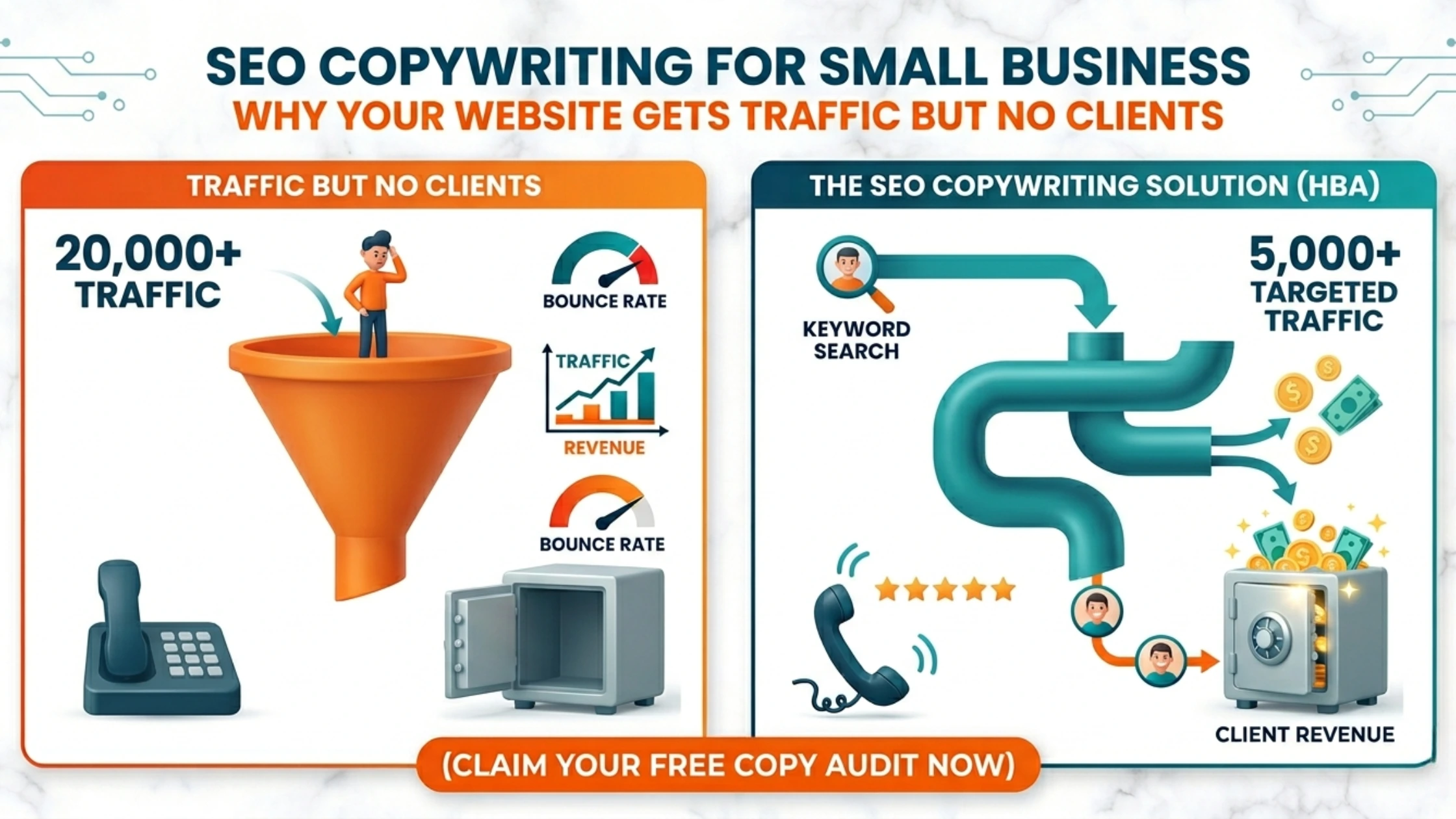
Your website might need SEO Copywriting. Your website has a split personality — and it’s costing you clients on two fronts simultaneously. On one side: businesses whose websites rank on Google but convert no one. They get the traffic. They get the visits. They watch the bounce rate climb and the phone stay silent. The words on their pages might be fine, but they’re not designed to sell. They describe the service without speaking to the person searching for it. They use industry language instead of client language. They list features instead of outcomes. They have five different calls to action competing for attention, which means they have none.
On the other side: businesses whose websites read beautifully but sit invisible on page three of Google, or don’t appear at all. Polished, professional, articulate — and completely unfindable to the clients they were written to attract. Because nobody optimized them for search. Nobody researched what those clients actually type into Google. Nobody structured the content in a way that tells Google what the page is about and why it deserves to rank.
SEO copywriting for small businesses is the discipline that solves both problems at once. Not SEO and then copywriting as two separate projects. Not ranking and then converting as two separate goals. One strategy. One process. Words that bring the right people to your website and persuade them to take action when they arrive.
This guide will explain exactly why the split-personality problem exists, what it’s costing you in real money, and how strategically crafted content — built around how your clients search, how they think, and what they need to hear before they trust you — transforms your website from an expensive digital brochure into your hardest-working salesperson.
The Two Failures That Kill Small Business Websites
Most business owners think about their website as a single thing that either works or doesn’t. In reality, a website can fail in two completely separate ways — and most small business websites are failing at least one of them.
Failure Mode 1: Traffic Without Conversion
This is the frustrating one. You’ve invested in SEO. Traffic is coming in. Google Analytics shows hundreds or even thousands of monthly visitors. And yet — inquiries are sparse, consultations are rare, and the correlation between website visitors and actual new clients is almost nonexistent.
Here’s the data behind why this happens so commonly:
The average website conversion rate across all industries is 2.35%. That means for every 100 visitors, fewer than three take any meaningful action. The top 25% of websites convert at 5.31% or higher — more than double the average. The difference between these two groups is almost entirely about the quality and clarity of their messaging.
70% of small business websites have no effective call to action, according to HubSpot research. Not a weak CTA. No CTA at all. Visitors arrive, consume information in whatever order they choose, and then leave — because nobody told them what to do next.
Poor grammar or spelling in web copy can increase bounce rate by 85%. Even minor language mistakes signal unprofessionalism and send visitors away before they engage with the substance of what you offer.
Brands with clear messaging see up to 23% higher conversion rates than those with vague or jargon-heavy copy. The words you use — specifically, whether they speak directly to your client’s felt problem or to your own industry’s internal language — determine whether visitors stay or leave.
And here’s the hidden cost of that gap: if your website generates 500 visits per month and converts at 0.5% instead of 3%, you’re getting 2–3 leads instead of 15. At a $3,000 average project value and a 30% close rate, that’s the difference between roughly $2,700 and $13,500 in monthly revenue from the same traffic. $10,000 per month in lost opportunity — not from traffic problems, but from copy problems.
Failure Mode 2: Beautiful Copy, No Audience
This is the quieter failure. The website reads well. Someone who visits it is impressed. But that “someone” is almost never a new client, because the vast majority of people who could become clients never find the page.
94% of all webpages receive zero traffic from Google. This isn’t a negligible minority — it’s the overwhelming reality of what happens to content that hasn’t been strategically built around search intent.
Only 1% of all webpages receive more than 10 clicks per month from Google. Everything else is effectively invisible to the people who need it most.
The reason isn’t that those pages are poorly written. It’s that they were written without anyone first asking: what words does my ideal client type into Google when they have the problem my service solves?
When copywriting happens without keyword research, the result is beautiful, articulate content that answers questions nobody searched for. A law firm that writes about “comprehensive legal strategy solutions” instead of “business contract attorney in Chicago.” A marketing agency that leads with “innovative digital presence management” instead of “SEO services for small businesses.” A consultant who writes about “organizational transformation” instead of “how to improve employee retention.”
The client is searching in their language. The website is written in the business’s language. The gap between the two is the gap between traffic and invisibility.
Why SEO Copywriting Must Work Together — Not Separately
Here’s where most businesses get this wrong. They treat SEO and copywriting as sequential projects rather than a unified discipline:
First, we’ll do SEO to get the traffic. Then we’ll improve the copy to convert it.
Or:
First, we’ll get the website written professionally. Then we’ll optimize it for search.
Both sequences are expensive mistakes.
SEO without copywriting produces pages that rank for terms that don’t convert. High volume, low intent keywords that bring curious people, not buyers. Or technically optimized pages where every keyword is present, but the sentences don’t persuade anyone to do anything. Rankings that generate pride in reports but no revenue in bank accounts.
Copywriting without SEO produces pages that are persuasive to the rare visitor who finds them but structurally invisible to the search engine that determines whether anyone ever does. Headlines that resonate emotionally but contain no keyword that anyone searches for. Service descriptions that are compelling to read but tell Google nothing useful about the query they should answer.
SEO copywriting — the unified discipline — starts with understanding what your ideal client is actively searching for, then crafts content that answers that search with authority and converts the reader with persuasion. The keyword is the door. The copy is the room. One gets people in. The other makes them stay.
A thought leadership SEO campaign — the most comprehensive version of this approach — delivers a 748% ROI according to FirstPageSage’s industry benchmarks. That’s not from traffic alone. It’s from traffic that converts, generated by content that was built to accomplish both goals simultaneously from the first word.
The 8 Copywriting Problems Costing Small Businesses the Most Money
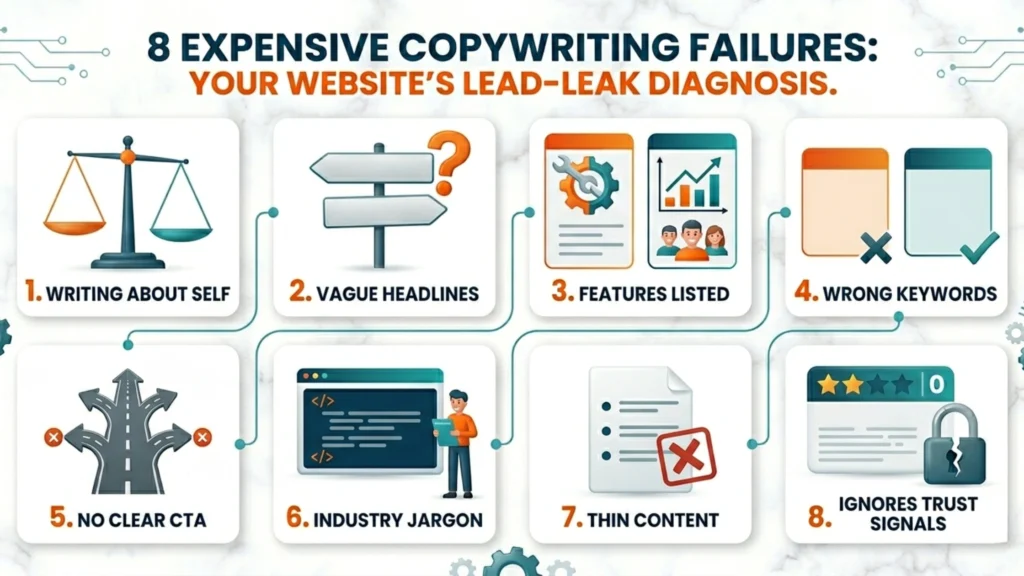
Understanding that copy matters is one thing. Knowing exactly which copy problems to fix is another. These are the eight most expensive copywriting failures appearing on small business websites right now:
Problem 1: You’re Writing About Your Business Instead of Your Client’s Problem
This is the single most pervasive and costly copy mistake in small business websites.
Walk through your homepage right now. Count how many sentences start with “We” or “Our.” Then count how many start with “You” or “Your.”
The ratio reveals your problem. Most small business homepages open with: “We are a full-service [industry] firm dedicated to delivering exceptional [service type] for [vague audience].” The entire opening paragraph is about the business. The visitor — who came to that page because they have a specific problem — is forced to translate your self-description into a solution for their situation. Most of them don’t bother. They leave.
The page that converts opens instead with: “Your [specific situation] is costing you [specific loss]. Here’s why — and how to fix it.”
This isn’t just a stylistic preference. It’s the fundamental architecture of persuasion. Humans are wired to pay attention to content that’s about them. Content that opens with their pain, speaks to their fear, names their specific situation — that content earns attention and trust before a single credential has been mentioned.
The fix: Rewrite your above-the-fold copy using the problem-first framework: “We help [specific audience] [achieve specific outcome] without [specific frustration].” Every sentence above the fold should be oriented around the visitor’s world, not yours.
Problem 2: Vague Headlines That Could Apply to Any Business in Any Industry
Your headline is doing two jobs simultaneously: it signals to Google what the page is about, and it tells the visitor in under 5 seconds whether this page is relevant to them.
Most small business headlines fail both jobs with phrasing like:
- “Excellence in [Industry]”
- “Your Trusted [Service] Partner”
- “Innovative Solutions for Modern Businesses”
- “Quality You Can Count On”
These phrases pass the “could this be on any competitor’s website?” test — because they could. They communicate nothing specific about who you help, what outcome you deliver, or what problem you solve. They give Google nothing to rank and give visitors no reason to stay.
The fix: Apply the clarity-first headline formula: Outcome + Target Audience + Differentiator. Not “Marketing Solutions for Your Business” but “More Consultation Bookings from Your Website — Without Rebuilding From Scratch.” Not “Professional Legal Services” but “Business Contract Attorney in [City] — Protecting Small Business Owners Since 2012.”
The headline that converts and ranks is specific enough that only your ideal client reads it and thinks: That’s exactly what I need.
Problem 3: Features Listed, Benefits Absent
“We offer 24/7 customer support.” — Feature.
“You’ll never wait until Monday to resolve a client crisis.” — Benefit.
“We use the latest SEO tools and techniques.” — Feature.
“Your competitors will wonder how you’re appearing above them for every search your clients make.” — Benefit.
The distinction seems simple. But the majority of small business service pages list features — what the service includes — without translating those features into the outcomes the client actually cares about. Clients don’t buy features. They buy the life or business that those features create for them.
This matters doubly for SEO. When a client searches “how do I get more leads from my website,” they’re not searching for “technical website optimization services.” They’re searching for the outcome: more leads. A page that leads with the outcome — “Turn Your Website Into a Lead-Generating Machine” — matches their search intent. A page that leads with the service — “Comprehensive Digital Optimization Solutions” — doesn’t.
The fix: For every feature in your copy, ask “so what does that mean for the client?” and add that answer. Build your service pages around outcomes first, then explain the process that delivers them.
Problem 4: Wrong Keywords, Wrong Intent, Wrong Audience Landing
Keywords are not all equal. And choosing the wrong ones wastes every dollar of SEO investment.
The most expensive keyword mistake small businesses make is targeting high-volume, low-intent keywords because the volume looks impressive in tools, while neglecting the lower-volume, high-intent keywords that actually bring buyers.
Someone searching “what is SEO” has informational intent. They’re learning, not buying. If your service page targets “what is SEO,” you’ll attract curious people at the beginning of a research journey — not businesses actively looking to hire an SEO agency.
Someone searching “hire SEO agency for law firm Chicago” has transactional intent. They’re ready to make a decision. This search volume might be much lower, but every person making it is worth dramatically more to your business.
The data confirms this: SEO converts 7.3 times more than PPC in financial services and 3.4 times more in legal services — but only when the keyword strategy is built around buyer intent, not search volume.
The fix: Before writing any page, map the keyword to its intent. Informational intent (what is, how does, why does) → blog content and educational guides. Commercial intent (best, top, compare) → comparison and category pages. Transactional intent (hire, services, agency, company near me) → service pages and landing pages. Write service pages around transactional and commercial keywords. Don’t let them rank for informational traffic that never converts.
Problem 5: No Clear CTA — Or Too Many Competing Ones
Every page of your website has a visitor making a decision: stay and engage, or leave and search elsewhere. The call to action is the mechanism that captures engagement and converts a decision-in-progress into an action taken.
70% of small business websites have no effective call to action. Visitors read the content and leave, not because they were unconvinced, but because nobody told them what to do next.
But there’s a second failure that’s equally damaging: too many CTAs on the same page. A page that offers “Book a Call,” “Download our Guide,” “View Our Portfolio,” “Read Our Blog,” and “Connect on LinkedIn” simultaneously isn’t giving visitors five paths to engagement — it’s creating decision paralysis. When everything is a priority, nothing is. Visitors faced with too many options frequently make the easiest choice: they leave.
The fix: Every page needs one primary CTA — the single most important action you want the visitor to take. Make it specific (“Get My Free Website Audit“), benefit-led (“Claim Your Free SEO Analysis”), and visually prominent. Place it above the fold, midway through long pages, and at the bottom.
Personalized CTAs — those tailored to where the visitor is in the decision process — convert at 202% higher rates than generic ones. “Get My Free Audit” converts significantly better than “Contact Us.” The specificity of the action and the clarity of the value it provides determine whether visitors click or scroll past.
Problem 6: Copy Written in Your Industry’s Language, Not Your Client’s
Every industry develops its own internal language — terminology that practitioners use fluently among themselves, but that means little or nothing to the clients they serve. When website copy is written in that internal language, it creates distance rather than connection.
A web agency that writes “we deliver omnichannel digital transformation through agile methodology and iterative sprint cycles” is communicating in developer language to a business owner who thinks in terms of sales, clients, and revenue.
That same agency writing “we fix the parts of your digital presence that are costing you clients — your website, your search visibility, and the content that should be converting visitors” is communicating in client language.
Google also responds to this distinction. Search engines optimize around the language people actually use when they search — not the language industries use to describe themselves internally. A page written in the client language ranks for the terms clients search. A page written in industry jargon ranks for terms practitioners search — and practitioners rarely become clients.
The fix: Read your copy aloud and ask: “Would a business owner who knows nothing about this industry understand exactly what this means?” If any phrase requires industry knowledge to understand, rewrite it in outcome language.
Problem 7: Thin Content That Google Won’t Promote
Content depth is a ranking signal. Not because Google rewards word count, but because comprehensive content that genuinely covers a topic tends to satisfy more of what searchers are looking for — and Google’s entire mission is to satisfy searchers.
A service page with 150 words and three bullet points is competing against pages with 800 words that explain the service in depth, address common questions, provide relevant context, and give Google clear signals about what problem the page solves.
The #1 organic result in Google averages significantly more content than pages ranking below it — not because volume wins, but because depth signals authority. A page that thoroughly explains what a service does, who it’s for, what results it delivers, what the process looks like, and what clients say about it will consistently outrank a page that stops at a brief service description.
This matters most for service pages, which are the pages that need to convert as well as rank. Thin service pages that say “we offer SEO services — contact us to learn more” give Google nothing to rank and visitors nothing to trust.
The fix: For each core service page, aim for 800–1,500 words that answer: What is the service? Who needs it? What problem does it solve? What does the process look like? What results can clients expect? What do existing clients say? What is the next step? This depth ranks better and converts better — because a thorough page builds trust that a thin one cannot.
Problem 8: Copy That Ignores Trust Signals
Trust is the invisible conversion factor. A visitor can be convinced that they need your service and still not contact you — because they haven’t yet determined that they can trust you specifically to deliver it.
75% of consumers judge a company’s credibility based on its website design and copy. Not just whether the website looks good, but whether the words on it feel credible, specific, and honest.
The copy elements that build trust are often the ones most neglected on small business websites:
Social proof: Testimonials with real names, specific outcomes, and verifiable details. Not “Great service, would recommend” — but “HBA diagnosed the exact reason our Google rankings weren’t moving and fixed it in 6 weeks. We went from invisible to page one for our three most important keywords.”
Specificity: Numbers, timelines, and concrete results. “We’ve helped 110+ businesses. ” Outperforms. ” We’ve helped many businesses.” Specificity signals honesty because vague claims are the calling card of businesses with nothing specific to prove.
Transparency about process: Clients who understand what they’re buying feel safer buying it. Describing your diagnostic process, your delivery timeline, and what the working relationship looks like reduces perceived risk and increases conversions.
E-E-A-T signals: Google’s framework — Experience, Expertise, Authoritativeness, Trustworthiness — is built around exactly the trust elements that also convert human readers. Content that demonstrates genuine expertise and real-world experience ranks better and persuades better simultaneously.
What Google-Ready, Client-Friendly Copy Actually Looks Like
To make this concrete, here’s what strategically crafted SEO copywriting looks like at the page level — using HBA’s own service pages as the model:
Homepage: Opens with the client’s problem (“Your competitors are getting the calls you should be getting”), states the specific outcome (“HBA Web Solutions finds the leaks in your business — and fixes them with solutions you can measure”), includes a specific trust signal (“110+ businesses fixed”), and delivers one clear CTA (“Fix My Web Problems”).
Service Pages: Each service has its own dedicated page — not a single “Services” page with bullet points. Each page targets one transactional keyword phrase (“organic SEO agency,” “WordPress development agency,” “SEO copywriting services”), opens with the problem that the service solves, describes the process, includes specific outcomes from existing clients, and closes with a low-friction CTA.
Blog Content: Each article targets one specific search query made by business owners at the moment they’re experiencing a problem HBA can solve. The content answers that query thoroughly, demonstrates expertise through specific data and genuine diagnosis, and closes with a natural bridge to the relevant service.
Every Page:
- Primary keyword in the title, first paragraph, and at least one H2
- Secondary keywords are distributed naturally throughout the body
- One primary CTA per page
- Social proof is embedded where trust is needed most
- Content depth sufficient to satisfy both the reader and Google
This is the architecture of copy that ranks and converts — and it’s the gap most small business websites have between their current state and their potential.
The SEO Copywriting Process: From Blank Page to Ranked, Converting Content
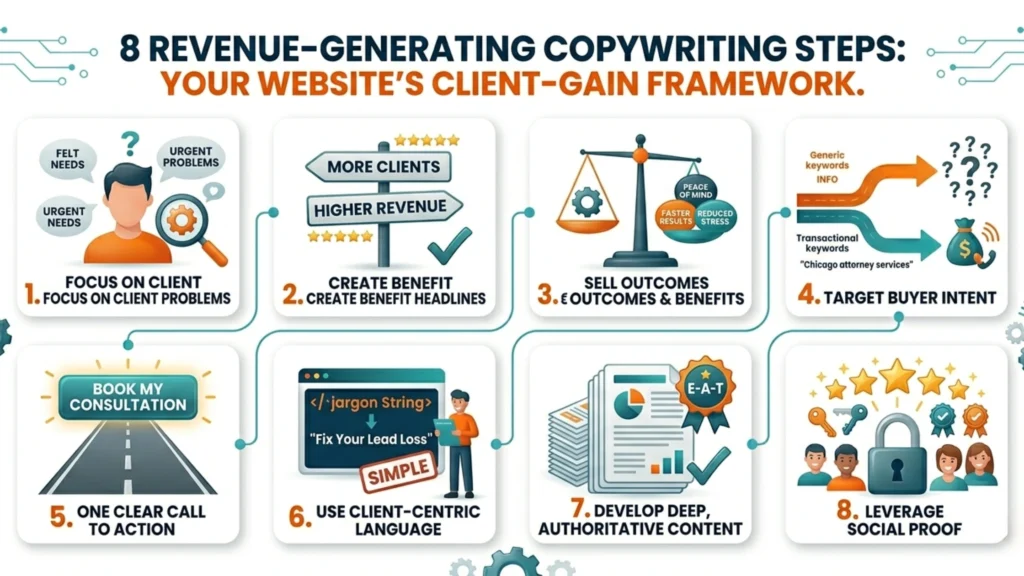
Here’s how professional SEO copywriting actually works — not in theory but in the sequence that produces results:
Step 1: Audience and Intent Research (Before Any Writing Begins)
Who is the ideal client? What specific words do they use when they’re frustrated with the problem your service solves? What questions are they Googling at 11 PM when the problem feels urgent? What fears are they bringing to the search bar alongside their question?
This isn’t demographic research. It’s linguistic research. The goal is to understand the exact vocabulary of the client’s pain — so the copy uses their words, not yours.
Step 2: Keyword Research with Intent Mapping
Every page needs a target keyword — one primary phrase that the page is built around. That keyword is chosen based on three factors:
- Search volume (is anyone searching for this?)
- Keyword difficulty (can this page realistically rank for it?)
- Search intent (Is the person searching for this phrase in a position to become a client?)
The third factor is the most important and the most commonly ignored. A keyword with 10,000 monthly searches and informational intent produces traffic that never converts. A keyword with 500 monthly searches and transactional intent produces inquiries.
Step 3: SERP Analysis Before Writing
Before writing a single word, examine what currently ranks for the target keyword. What content formats are Google promoting? What questions are appearing in the People Also Ask box? What topics appear consistently across the top-ranking pages?
This analysis reveals what Google has determined users actually want when they make this search — and a page that comprehensively covers those elements while adding unique value has a strong foundation for ranking.
Step 4: Structuring for Skimmers and Readers
Most website visitors scan before they read. They look at headlines, subheadings, and bolded text first — and if those elements don’t hook them, they never read the body paragraphs at all.
Strategic copy structure means the skeleton of the page — its headlines, subheadings, and highlighted phrases — tells the complete story for skimmers while the body provides depth for the readers who decide to engage fully.
Short paragraphs: 2–4 sentences maximum. White space signals readability and invites reading.
Subheadings every 200–300 words: They create breathing room, signal structure to Google, and give skimmers entry points back into the content.
Bold text for key insights: The single most important sentence in each section should be bolded. This creates visual anchors that guide the reader’s eye even when they’re not reading every word.
Step 5: Writing Headlines That Hook and Rank
The headline is doing two jobs that must both succeed:
For Google: It should contain the primary keyword, signal the page’s topic clearly, and match the search intent of the query it targets.
For the reader: It should create enough curiosity, relevance, or urgency that they choose this result over the nine others on the page and stay once they arrive.
These jobs can feel contradictory — keyword inclusion can feel mechanical, while emotional hooks can feel keyword-light. The resolution is to write headlines that use the keyword within a genuinely compelling frame:
Not: “SEO Copywriting Services” But: “SEO Copywriting for Small Business: Rank AND Convert”
Not: “Website Design Services” But: “Why Your Website Looks Good but Gets Zero Leads (And How to Fix It)”
The first version of each satisfies neither goal. The second satisfies both.
Step 6: The Opening That Hooks and Answers
The first 100 words of any piece of content are disproportionately important — to Google and to readers.
For Google: the primary keyword should appear naturally in the first paragraph, confirming that the page is relevant to the searched query.
For readers: the first paragraph should either state the problem they’re experiencing (making them feel understood) or state the answer to the question they searched (making them feel rewarded for clicking).
The best openings do both simultaneously. They name the specific problem that led to the search, preview the answer that the content will provide, and create enough curiosity or urgency that the reader wants to continue.
Step 7: The Close That Converts
Every piece of content needs to end with a reason to act. Not just a restatement of value — a specific, friction-reduced path to the next step.
The mistake most content makes is ending abruptly or ending with a generic “contact us for more information.” A closing that converts:
- Summarizes the core diagnosis of the content provided
- Restates the cost of the problem remaining unsolved
- Offers a specific, low-risk next step (free audit, free consultation, free review)
- Removes objection by describing what happens after the step is taken
This structure — diagnose, agitate, invite, de-risk — is the PAS framework applied at the content level. It’s the difference between a closing that produces inquiries and one that produces polite exits.
Why DIY Copywriting Costs More Than Professional Copywriting
Business owners often attempt to write their own website copy for understandable reasons: nobody knows the business better than you, and professional copywriting represents a real cost.
But the math of DIY copywriting rarely favors the business owner, for two specific reasons:
The curse of knowledge. The more deeply you understand your own business, the harder it becomes to write about it in the language your clients use. You know what your service does at a technical level that most clients don’t need to understand. The result is a copy that describes the process rather than the outcome — that speaks to practitioners rather than buyers.
The conversion gap. If your website is currently converting at 0.5% and professional copywriting raises that to 2.5%, the 2% improvement generates five times more leads from the same traffic. At 500 monthly visitors and a $3,000 average client value, that’s the difference between roughly $7,500 per month and $37,500 per month in potential revenue from your website. The SEO copywriting investment pays for itself within the first converted lead — often within the first month.
Consumers are 131% more likely to buy from a brand after reading educational content that genuinely addresses their concerns and demonstrates expertise, according to Conductor research. Professional SEO copywriting produces exactly this content — thorough, expert, client-centered, and built around what searchers are actually looking for.
The Copy Audit: 12 Questions That Reveal Your Website’s Biggest Gaps
Before investing in new copy, understand specifically where your current copy is failing. Work through this checklist on your most important pages:
Clarity:
- Can a stranger understand what you do and who you help within 5 seconds of landing on your homepage?
- Is your headline specific enough that it couldn’t appear on a competitor’s website unchanged?
- Does your above-the-fold copy speak to your client’s problem, not your company’s credentials?
Keywords and Intent:
- Does each service page target one specific transactional keyword phrase?
- Does that keyword appear in the page title, first paragraph, and at least one H2?
- Are your target keywords the phrases your clients actually search — not the phrases you use internally?
Conversion:
- Does every key page have exactly one primary CTA?
- Is that CTA specific and benefit-led (not just “Contact Us”)?
- Is the CTA visible without scrolling on desktop and mobile?
Trust:
- Does each page include at least one specific client testimonial with a real outcome?
- Is there proof of results — numbers, timelines, specific achievements?
- Does the copy explain your process clearly enough that a prospect knows what to expect?
If you answered “no” to more than four of these, your copy is actively costing you leads — and the gap between your current conversion rate and what’s possible with strategic copy represents significant monthly revenue.
The Bottom Line
Every word on your website is either:
Bringing the right people to find it on Google, or sending the wrong people there who’ll never buy. Convincing visitors that you understand their problem and can solve it, or giving them a reason to leave. Building enough trust that someone reaches out, or failing the silent credibility test that happens before any contact is made
Your website’s copy is not a neutral element. It’s either actively generating leads or actively losing them — often simultaneously. Traffic with no copy depth produces visitors who don’t convert. Great copy with no keyword strategy produces content that nobody finds. The intersection — where rigorous keyword research meets genuinely persuasive, client-centered writing — is where small business websites stop costing money and start making it.
That intersection is what HBA Web Solutions’s SEO Copywriting Services are built to create.
We don’t write for search engines. We don’t write to fill pages. We diagnose what your ideal client is searching for, write copy that shows up for those searches, and craft every word to move the person who arrives closer to the decision to reach out. Then we measure it — because solutions you can’t measure aren’t solutions.
Get your free Copy Audit from HBA Web Solutions. We’ll review your homepage, your service pages, and your highest-traffic blog content — and tell you specifically what’s preventing your copy from ranking higher, converting better, and turning more of your existing traffic into paying clients. No jargon. No vague recommendations. A precise diagnosis and a prioritized action plan.
-
What’s the difference between SEO copywriting and regular copywriting?
Regular copywriting optimizes for persuasion and conversion — it focuses on compelling the reader to take action. SEO copywriting accomplishes both simultaneously: it’s written to rank in search engines and convert the visitors those rankings generate. The difference in process: SEO copywriting starts with keyword research and search intent analysis before a single word is written. Regular copywriting can skip those steps and still succeed in contexts where traffic is driven by paid ads or social media. For small businesses that rely on organic search for visibility, SEO copywriting is the only version that generates sustainable ROI.
-
How quickly does SEO copywriting produce results?
In two distinct timeframes. Conversion improvements on existing pages — from improved clarity, stronger CTAs, and more persuasive messaging — can show measurable impact within days or weeks of publishing updated copy. Ranking improvements from SEO-optimized content typically take 3–6 months to materialize for most keywords, as Google indexes, evaluates, and ranks new and updated pages. The combination — better copy that ranks better and converts better — typically produces compound results over 3–12 months that continue improving as content authority accumulates.
-
Can I improve my existing copy rather than replacing it entirely?
Absolutely — and for most businesses, this is the smarter starting point. A copy audit typically reveals 3–5 high-priority fixes that will generate the most improvement in the shortest time: a clarified homepage headline, an added CTA, a service page expanded with client-focused benefit language, and a few keyword optimizations in meta titles and H1s. These targeted improvements often produce 80% of the conversion lift at 20% of the cost of a full rewrite. Strategic improvement first, comprehensive rewrite where justified.
-
Should every page have different copy, or is it okay to reuse language across pages?
Every page should have unique copy targeting its own specific keyword and audience segment. Duplicate or near-duplicate copy across pages confuses Google about which page to rank for which query — and typically results in neither page ranking well. More importantly, different pages serve different visitor intentions. A homepage visitor is orienting to your business. A service page visitor has already decided they need the service and is evaluating whether you’re the right provider. An FAQ page visitor has a specific question. Copy that doesn’t match the visitor’s intent at each stage loses them at each stage.
-
What results should I realistically expect from professional SEO copywriting?
For a service business with existing website traffic but poor conversion: a 100–400% improvement in conversion rate is achievable within 60–90 days of implementing strategic copy improvements. For a business with good copy but poor rankings: meaningful ranking improvements for 3–5 target keywords within 3–6 months of publishing properly optimized content. For businesses with both problems: a 6–12 month timeline to establish ranking, traffic, and conversion improvements that compound over time — typically producing an ROI of 300–750% annually on the copy investment when measured against new client value generated.