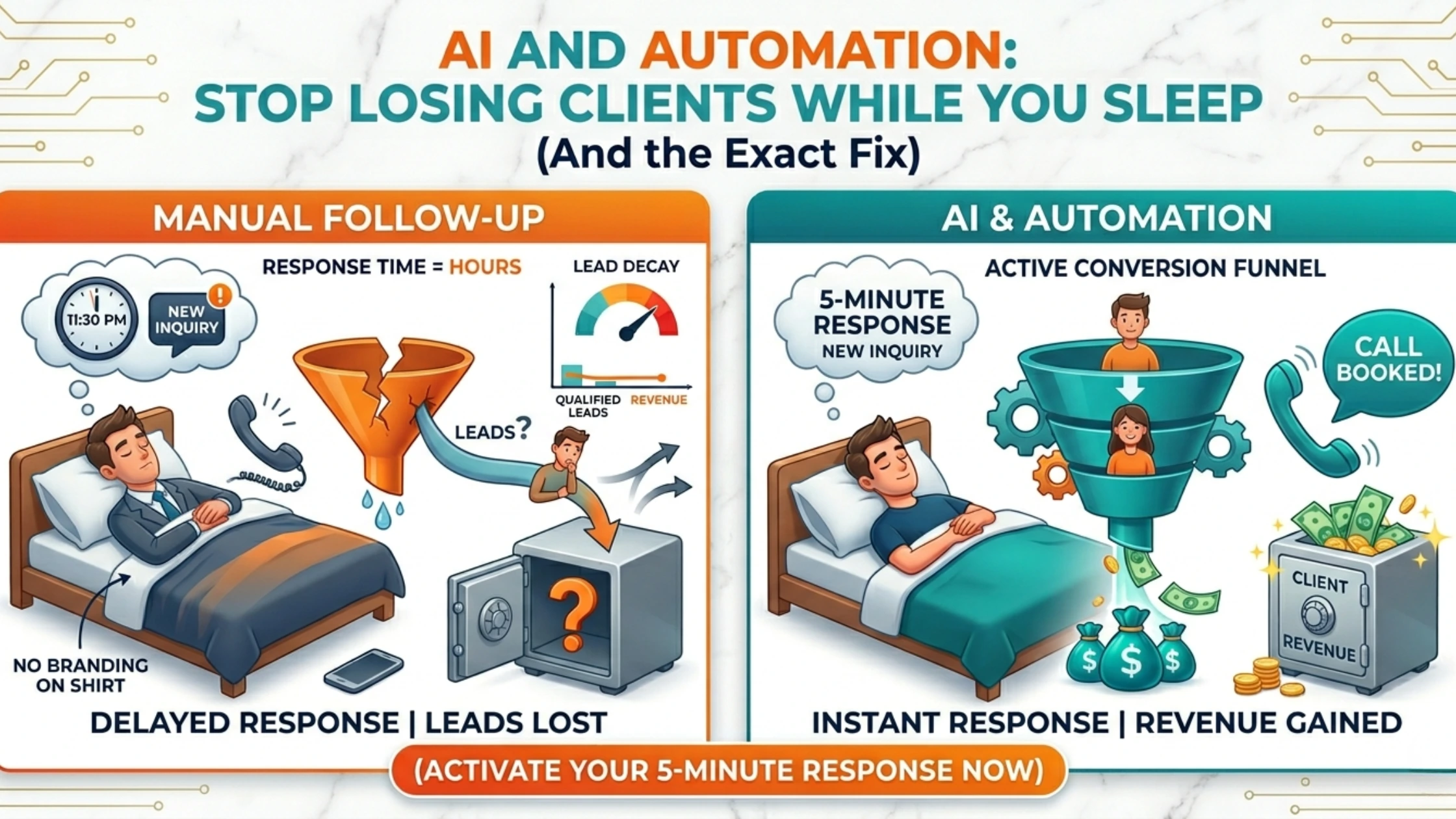
Today, AI and automation are the guarantee of your independence if you are a business owner. It happened again last night. Someone found your business. They were interested — genuinely interested. They filled out your contact form at 9:47 PM, typed out a real question, and hit submit. They were ready. Their problem was fresh, their intent was high, and they were hoping you’d be the one to solve it.
By morning, they’d already heard back from your competitor.
You replied to their inquiry at 9:15 AM — a perfectly reasonable business hour. But for that lead, you weren’t the first. You were the follow-up. And follow-ups rarely win.
This is the silent revenue leak that AI and automation for small business lead generation was built to seal. Not someday. Right now. In 2026, the tools exist, they’re affordable, and the businesses deploying them are pulling ahead of everyone still relying on manual follow-up.
Here’s the uncomfortable truth this guide is going to prove to you with numbers: the speed of your response to a new lead matters more than the quality of your service, your price, your reputation, or your years in business. The fastest responder wins the majority of deals — not because they’re better, but because they’re first. And AI is the only way to be first every single time, without hiring a team member whose sole job is to watch your inbox around the clock.
By the end of this guide, you’ll understand exactly why leads are slipping away, what happens in the minutes after someone inquires that determines whether you win or lose the deal, the specific AI automation tools that solve this, and how service businesses in law, real estate, consulting, and professional services are using AI to fill their calendars without working extra hours.
Let’s get into it.
The Lead Response Crisis Nobody Talks About
Before we discuss the solution, you need to understand the full scale of the problem, because most business owners vastly underestimate how badly a slow response is costing them.
Here are the statistics that should change the way you think about every lead inquiry you’ve ever received:
The average business takes 42 hours to respond to a new lead. Not 42 minutes. Forty-two hours. Almost two full business days. By that point, the prospect has either solved their problem another way, forgotten why they reached out, or signed a contract with whoever responded first.
78% of buyers choose the first company that responds to their inquiry — regardless of price, quality, or brand recognition. This isn’t about being the best option. It’s about being the fastest one. First contact has an almost gravitational pull on buying decisions.
Responding within 5 minutes makes you 21 times more likely to qualify a lead compared to responding after 30 minutes. And responding within the first minute? That can increase conversions by up to 391%.
Waiting more than 5 minutes reduces your chances of qualifying a lead by 80%. The decay is not gradual — it’s a cliff. Interest spikes at the moment of inquiry and collapses remarkably fast.
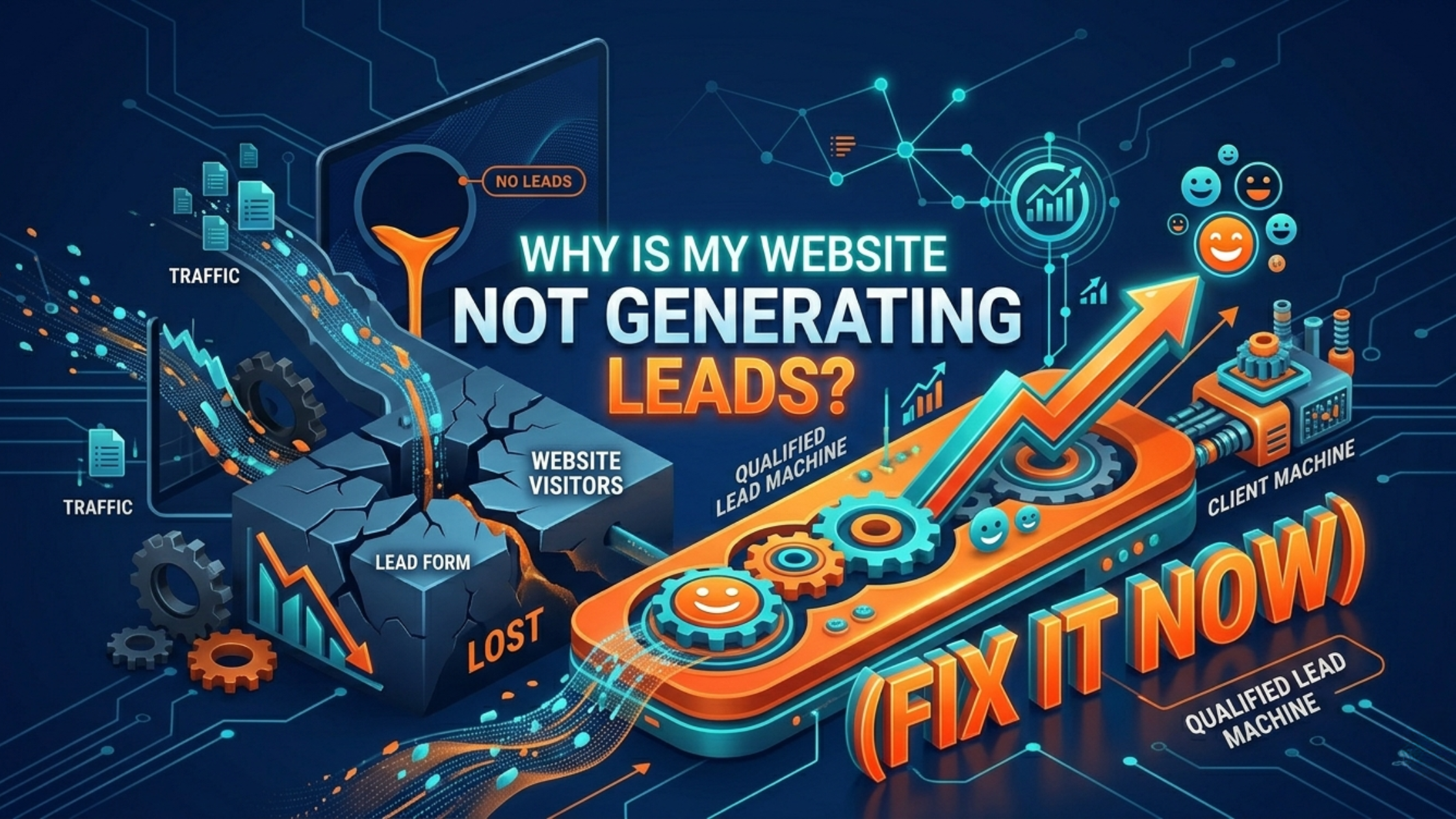
63.5% of companies never respond to leads at all. More than half. This is because leads come in at odd hours, get buried in inboxes, or fall through the cracks between team members. If you’ve ever had a lead “go cold,” there’s a meaningful chance it was never actually cold — it was just waiting for you when the timing was no longer right.
Now put these numbers in the context of your own business.
Suppose 20 people inquire about your services every month. If 78% go to the first responder, and your average response time is hours rather than minutes, you’re fighting for the scraps that other businesses left behind. The clients going to your competitor aren’t choosing them because they’re better. They’re choosing them because they showed up first.
This is the problem AI automation solves. Not by making you work harder. By making sure your business responds in seconds, every time, even while you’re in a meeting, on a job, or asleep.
Why “We’ll Get Back to You” Is No Longer a Business Strategy
There’s a deeper psychological reason why speed matters so profoundly in lead conversion — and it goes beyond just statistics.
When someone inquires about a service, they are in a moment of peak buying intent. Something happened that made their problem feel urgent enough to search for help, evaluate their options, and reach out. That moment is fragile. It has a window. And the window is measured in minutes, not hours.
Think about the last time you had a pressing problem. You searched, you found a few options, and you reached out to one or two. If the first one called you back within two minutes — warm, prepared, and helpful — did you really feel compelled to wait and see what the second one said? Of course not. You moved forward. The urgency was satisfied.
That’s the mechanism at work. A fast response meets the prospect at the peak of their urgency. A slow response meets them after the urgency has passed — or after someone else has already satisfied it.
The other dimension of this is trust. When a business responds immediately, it communicates something powerful: we are organized, we care about our clients, and this is how we operate. A fast response before the relationship even begins is a preview of the service the client can expect throughout the engagement.
A 47-hour response time communicates the opposite — even if it’s entirely a workflow problem rather than a cultural one. The lead doesn’t know you were in back-to-back client meetings. They only know they reached out, and you didn’t come back quickly. That’s the first impression. And first impressions compound.
This is why the solution isn’t “try harder to respond faster.” The human in the loop will always be slower than the moment demands, especially for service businesses where the owner is often the primary service deliverer. The solution is to remove the human from the first-response equation entirely — and let AI handle the moment of maximum intent so you can engage prospects who are already warm, already qualified, and already expecting you.
What AI and Automation Actually Do for Small Business Lead Generation
There’s a lot of noise around AI right now. Most of it is hype. But in the context of lead generation and follow-up for service businesses, the practical applications are concrete, measurable, and accessible even without a technical background.
Here’s what AI and automation actually do — not in theory, but in practice — for a business like yours:
1. Instant Lead Response, 24 Hours a Day, 7 Days a Week
An AI system connected to your website contact form, your social media inquiry forms, or your Google Business Profile messages can respond to a new lead within seconds of submission. Not with a generic “we’ll be in touch” auto-reply, but with a conversational, personalized response that acknowledges their specific inquiry, answers initial questions, and moves them toward the next step — usually booking a call or consultation.
This happens at 9 PM on a Tuesday. It happens at 6 AM on a Sunday. It happens during your busiest week when your inbox is overflowing. The AI doesn’t sleep, doesn’t get overwhelmed, and doesn’t have “better” leads it prioritizes over yours.
The impact: Businesses deploying AI for lead response report that companies using AI are 60% more likely to meet the 5-minute response standard than manual-only teams. That’s not a marginal improvement — it’s the difference between winning leads and losing them.
2. Lead Qualification Without Human Time
Not every inquiry is worth the same amount of attention. A well-configured AI system can qualify leads through conversational questions before any human gets involved — asking about budget, timeline, project scope, and specific needs. By the time a lead reaches your calendar for a consultation, you know they’re qualified. You’re not spending 30 minutes on a call to discover this person has no budget or timeline that works.
This changes how you spend your most valuable resource: your time. Instead of handling every inquiry from scratch, you engage only with prospects who have already indicated they’re the right fit.
3. Automated Booking — Calendars That Fill Themselves
One of the highest-friction moments in the lead-to-client journey is scheduling. The prospect is interested, you’re interested, but coordinating calendars turns into a 3-day email exchange that loses momentum with every reply.
AI-powered booking systems eliminate this entirely. The AI engages the prospect, determines their needs, confirms their availability, checks your live calendar, and books the consultation — all within the same conversation that started when they submitted their inquiry.
A real estate agency using AI lead qualification and booking increased qualified appointments by 45%, with agents spending 30% less time on unqualified inquiries. A clinic chain automated appointment scheduling via an AI chatbot, eliminating 4 hours of daily phone work per receptionist across 12 locations. These aren’t isolated experiments — they’re what happens when AI handles the administrative burden of converting interest into bookings.
4. Automated Follow-Up Sequences
Most sales happen after multiple touches. Research consistently shows that 50% of B2B sales happen only after the 5th follow-up — yet most business owners give up after one or two. The reason isn’t a lack of desire. It’s a lack of time and system.
AI-powered follow-up sequences handle this automatically. A lead who doesn’t respond to the first message gets a follow-up after 24 hours. A different follow-up at 48 hours. A final check-in at 72 hours. Each message varies slightly in tone and approach, maintaining relevance without feeling like spam.
This systematic persistence — which no manual process can maintain at scale — is often the difference between a lead that goes cold and one that eventually books. Because the fifth follow-up isn’t a sign of desperation. It’s a reminder that you’re still there, still interested, and still available to help.
5. Re-engagement of Dead Leads
Every service business has a graveyard of leads that went quiet — prospects who showed interest, then disappeared. Maybe the timing wasn’t right. Maybe they got busy. Maybe they hired someone else, and it didn’t work out.
AI automation can manage a structured re-engagement sequence for these leads — a series of value-add messages sent at intervals over weeks or months — that keeps your business in front of them without consuming your time. The leads that come back through this channel are often exceptionally ready to move forward, because their objection was never about you — it was about timing.
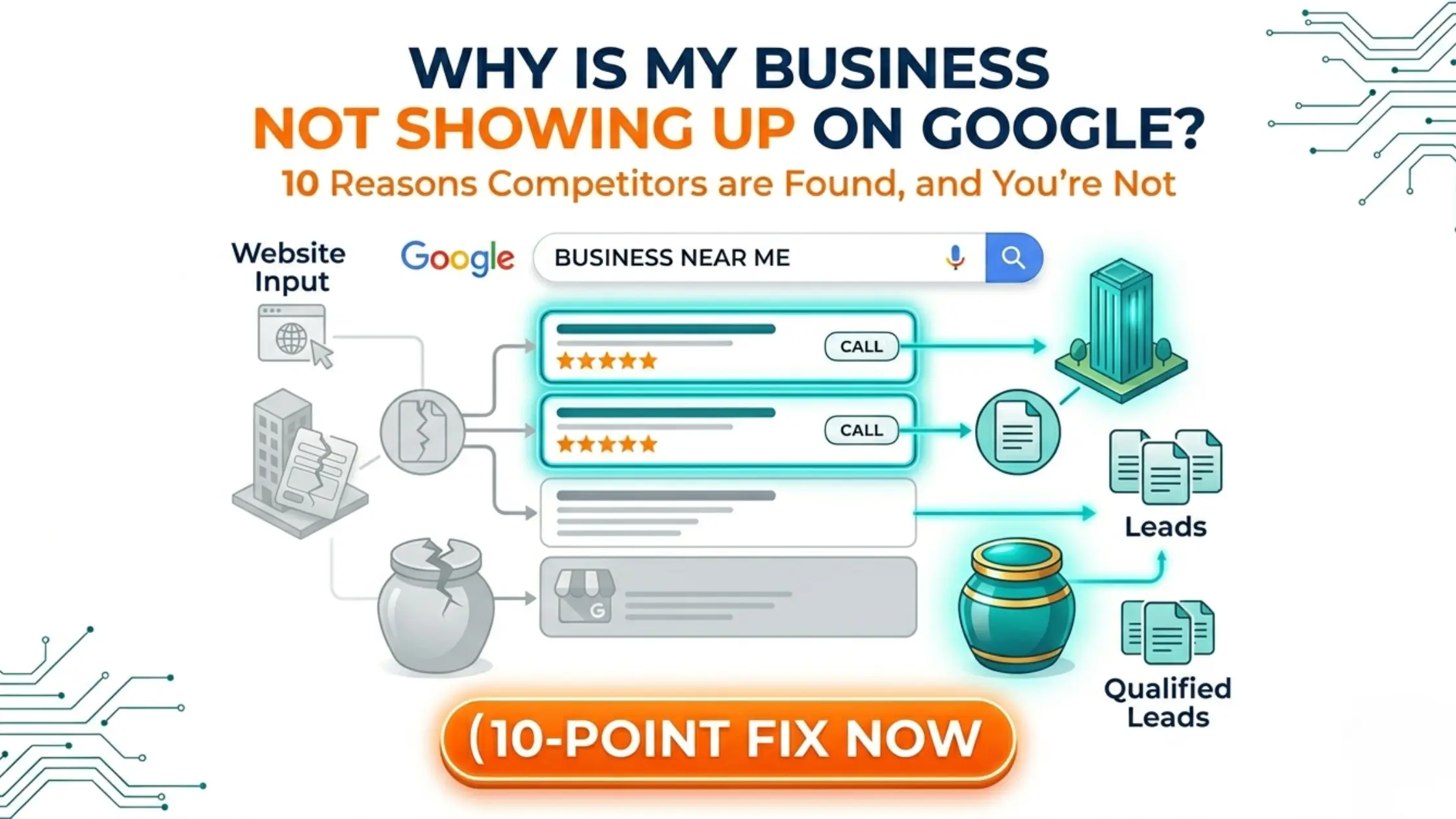
If you are sick of not showing up on Google. Your business is losing out on a big opportunity. Read our article on the possible reasons why you are invisible to your ideal target audience on Google.
The Numbers That Make AI Automation Impossible to Ignore
Let’s make this concrete. Here are the statistics that define where AI automation sits in 2026:
- 91% of small businesses using AI report that it boosts their revenue, according to Salesforce’s 2025 SMB research.
- 83% of growing small businesses have adopted AI, compared to only 55% of declining businesses. That correlation isn’t coincidental — it’s directional.
- The average chatbot ROI is approximately 1,275% based on support cost savings alone.
- AI chatbot interactions cost approximately $0.50 to $0.70 per interaction, compared to $6 to $8 for a human agent handling the same query.
- 57% of companies say chatbots deliver significant ROI within the first year of implementation.
- Businesses using AI for lead generation report a 50% increase in sales-ready leads and up to 60% lower customer acquisition costs.
- 80% of SMB AI users say AI is essential for reaching new customers, according to Thryv.
- The global AI automation market reached $169.46 billion in 2026, growing at a compound annual rate of 31.4% — not because businesses are experimenting, but because it works.
Here’s what these numbers mean for a service business with a modest volume of leads:
If you receive 15 inquiries per month and your current response time averages 8 hours, you’re likely qualifying fewer than 3 or 4 of those leads before they lose interest or go elsewhere. AI and automation that responds in under 5 minutes could meaningfully improve that qualification rate, potentially doubling or tripling the leads that make it to a conversation.
At a $3,000 average project value, the difference between qualifying 4 leads per month and qualifying 10 is $18,000 in potential monthly revenue. Against an AI tool cost of $50–$200 per month, this is one of the highest-ROI investments available to a small service business.
The businesses already using this aren’t doing anything magical. They’re just not losing leads to response time anymore.
The 5 Specific AI and Automation Workflows That Fix the Lead Problem
Understanding that AI helps is one thing. Knowing exactly which automation workflows to implement is another. Here are the five highest-impact AI workflows for service businesses:
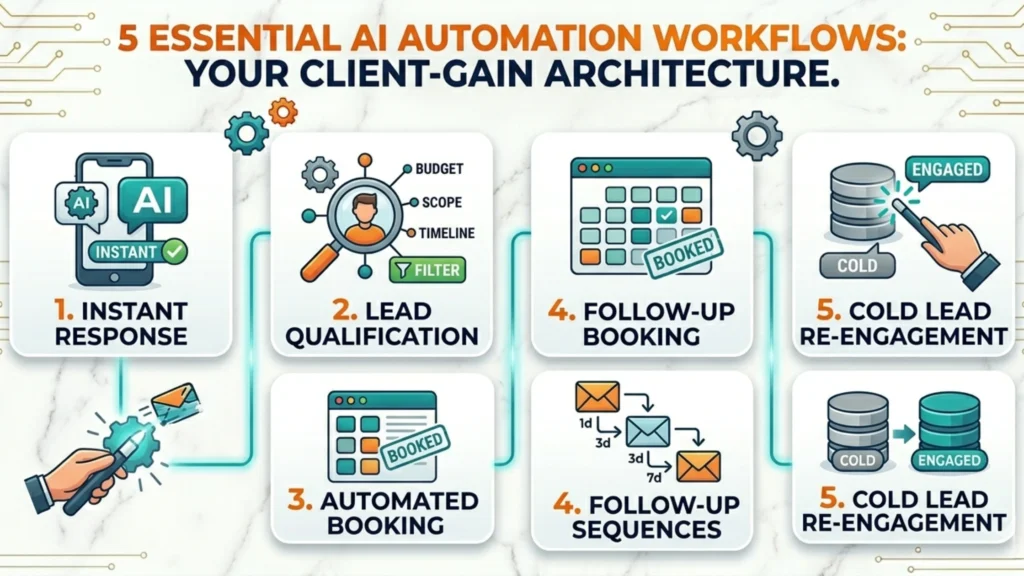
Workflow 1: The Instant Response System
What it does: Within seconds of a lead submitting any form — contact form, quote request, free audit request, landing page — an AI sends a personalized response that acknowledges their specific inquiry and asks the one most important qualifying question.
Why it matters: This is the automation that directly addresses the 78% statistic. The prospect gets an intelligent, relevant response before their interest peak passes. They feel heard. They continue the conversation rather than opening the next tab.
What it looks like in practice: A law firm prospect submits a contact form at 11:30 PM asking about business litigation. Within 30 seconds, they receive a message: “Thanks for reaching out about business litigation — that’s an area we work in regularly. To make sure we connect you with the right attorney, can you tell me a bit about the nature of the dispute?” This is not a generic autoresponder. It’s the beginning of a real conversation, initiated at the exact right moment.
Tools that enable this: Zapier or Make (formerly Integromat) connected to AI platforms like OpenAI or Claude can be configured to handle this without code. Dedicated platforms like GoHighLevel include this natively.
Workflow 2: The Qualification Sequence
What it does: After the initial response, an AI conducts a structured qualifying conversation — gathering information about timeline, budget range, scope, and specific needs — before any human time is invested.
Why it matters: Most service businesses spend 25–35% of their client-facing time on discovery conversations with prospects who were never a good fit. The qualification sequence filters for fit before the consultation.
What it looks like in practice: A real estate consulting prospect responds to the initial AI message. The AI then asks three to five targeted questions about their situation: property type, location, timeline, and what specific outcome they’re trying to achieve. When the owner reviews their calendar the next morning, they see three booked consultations — each with a pre-completed qualification summary attached. Not three inquiries to call back. Three ready-to-advance conversations.
Workflow 3: The Automated Booking System
What it does: After qualification, the AI checks the owner’s live calendar, offers available slots, and books the consultation directly — without any human coordination.
Why it matters: The scheduling step kills momentum. Every additional exchange required before a meeting is booked is another opportunity for the lead to lose interest, get distracted, or book with someone else. Eliminating this friction has a direct impact on show rates and conversion.
What it looks like in practice: The prospect completes the qualification sequence at 7 PM on a Thursday. The AI says: “Based on what you’ve shared, a 30-minute strategy call would be a great next step. I can see availability on Friday at 2 PM or Monday at 10 AM — which works better for you?” The prospect replies. The AI books the slot, sends calendar invites to both parties, and adds the lead to the CRM. Done. No human touched this until the owner walked into the Friday 2 PM call.
Tools that enable this: Calendly, Cal.com, and HubSpot Meetings integrate with AI conversation flows. Purpose-built tools like Setter AI and My AI Front Desk handle both the conversation and the booking in one system.
Workflow 4: The Follow-Up Drip
What it does: For leads who don’t immediately respond or book, an automated sequence delivers 5 to 7 follow-up messages over a 2-week period — varying in tone, content, and channel — without any human action required.
Why it matters: The majority of leads that convert do so after multiple touches. The majority of businesses abandon follow-up after one or two attempts. This workflow closes the gap between where businesses give up and where leads actually convert.
What it looks like in practice: A prospect submits a form on Monday, gets the instant response, but doesn’t reply. On Tuesday, an automated follow-up is sent with a specific piece of value — a relevant blog post, a client result, or a quick insight about their stated problem. On Thursday, a different-tone follow-up checks in simply and directly. On the following Monday, a final message offers an easy out: “If the timing isn’t right, no problem at all — just let us know, and we’ll follow up when it is.” This message frequently gets responses. People appreciate being released from the implicit obligation, and it often triggers honest replies about the timeline.
Workflow 5: The Re-engagement Campaign
What it does: For leads in your database that have gone quiet over the past 60, 90, or 180 days, a structured AI-managed re-engagement sequence delivers periodic value-add content designed to revive interest without pressuring.
Why it matters: Circumstances change. The prospect who wasn’t ready three months ago may be under pressure now. The one who hired another agency may be disappointed with the results and looking for a better option. A re-engagement system keeps you in the conversation without requiring your ongoing time.
What it looks like in practice: A database of 120 past leads from the previous year. A 6-month re-engagement sequence delivers one valuable piece of content per month — each addressing a specific problem relevant to the lead’s original inquiry. No sales pitches. Just useful information. After 6 months, a small percentage of these leads re-engage and book. At a $3,000 average project value, even a 3% re-engagement rate converts 3-4 dead leads into new clients. Without a system, those clients go to someone else by default.
The Real Cost of Not Automating
Business owners often resist automation for two reasons: concern about losing the personal touch, and uncertainty about the cost.
Let’s address both.
On the personal touch question: the fear is that automated responses feel robotic and drive away prospects who want a human connection. This fear made sense in 2018 when chatbots were clunky, obviously automated, and frequently unhelpful. In 2026, AI-generated responses in a conversational context are indistinguishable from human-written ones when properly configured. More importantly, the choice isn’t between a warm human response and a robotic AI response. It’s between an AI response in seconds and a human response in 8 hours or 42 hours. The “personal touch” of a human response means nothing if the prospect is already talking to your competitor by the time you send it.
On the cost: a full AI automation stack for a service business — covering website chat, inquiry response, follow-up sequences, booking integration, and CRM logging — can be built and operated for $100–$400 per month, depending on the tools chosen and volume. That’s less than a quarter of what it would cost to hire even a part-time administrative person to handle the same functions — and the AI works 24 hours a day, every day, without sick days, training time, or HR complexity.
Now put that against the cost of not automating.
If your business generates 15 leads per month and loses even 5 of them to response-time-driven competitor wins, and your average project value is $3,000, you’re losing $15,000 per month in potential revenue to a problem that costs $200 per month to fix.
That’s not a technology cost. That’s a decision.
Which Service Businesses Benefit Most from AI Lead Automation?
AI automation for lead generation delivers the highest return in service businesses characterized by:
- High-value per client (law, consulting, real estate, financial services, web agencies) — where each converted lead represents significant revenue
- Long consideration cycles — where follow-up sequences can nurture prospects over weeks
- After-hours inquiry volume — where a significant portion of leads come in outside business hours
- Appointment-dependent sales processes — where booking a consultation is the critical conversion point
- Multiple leads per month — where manual follow-up creates a bottleneck even with a small team
If your business fits even two or three of these characteristics, AI automation for lead generation will generate measurable ROI within the first 90 days of implementation.
For HBA’s core client — the US-based SMB owner in law, consulting, real estate, or services — every one of these characteristics applies.
What AI Automation Doesn’t Replace
This guide has made a strong case for automation, and it’s worth being clear about what it doesn’t claim to replace.
AI doesn’t replace human relationships. The moment a lead advances past initial qualification to an actual conversation, human expertise, empathy, and relationship-building take over. AI handles the first mile. You handle the rest.
AI doesn’t replace strategic thinking. Configuring an effective AI automation workflow requires human understanding of your client’s psychology, your sales process, and what questions actually qualify a prospect. The automation executes the strategy you design.
AI doesn’t replace quality service delivery. Automation fills your calendar. What you do in those calendar slots determines whether those clients refer others, leave reviews, and come back. AI is a lead generation tool — not a substitute for excellent work.
The businesses that win with AI automation are the ones who use it to remove administrative friction from their pipeline, so they can spend more time doing excellent work and less time chasing inquiries that may or may not pan out.
Getting Started: A Practical 4-Step Rollout for Service Businesses
Implementing AI and automation for lead generation doesn’t require a technical background, a large budget, or a team of developers. Here’s the practical sequence:
Step 1: Audit Your Current Lead Response Process (Week 1)
Before you build anything, understand what you’re working with. Answer these questions:
- What’s your average response time to a new inquiry? (Be honest — check your sent folder)
- What percentage of inquiries come in outside business hours?
- How many leads per month do you receive, and how many do you convert to consultations?
- Where do most of your leads come from — website form, phone, social media, Google Business Profile?
- How many follow-up attempts do you typically make before giving up on a lead?
This audit reveals the specific leaks in your pipeline and tells you which automation to deploy first.
Step 2: Choose Your Entry Point (Week 2)
Don’t try to automate everything at once. Choose the single highest-impact entry point:
- If your biggest problem is late response time: Start with an AI response system connected to your primary lead form. Tools like GoHighLevel, HubSpot’s free tier, or a simple Zapier + AI integration can have this live within a week.
- If your biggest problem is scheduling friction: Start with an AI booking integration on your website. Calendly, with an AI introductory chatbot, is a starter solution; purpose-built tools like Setter AI are more sophisticated.
- If your biggest problem is leads going cold, Start with an automated follow-up sequence. Most CRMs (HubSpot, Zoho, Pipedrive) include workflow automation that can run follow-up sequences without AI — you can add AI-generated personalization later.
Fix one leak well before trying to fix three at once.
Step 3: Configure and Calibrate (Weeks 2–4)
Every AI tool requires configuration: your brand voice, your qualifying questions, your booking parameters, your follow-up tone. Spend time getting this right. The AI’s first messages represent your business — they should sound like you, ask the questions you’d ask, and guide prospects the way you’d guide them.
Run the system for 2 weeks before making judgments. Review the conversations the AI is having. Adjust the tone, the questions, and the flow based on what you observe. This is the difference between an AI that converts leads and one that frustrates them.
Step 4: Measure and Expand (Month 2 onwards)
Track three metrics from day one:
- Response time (target: under 5 minutes, ideally under 60 seconds)
- Lead-to-consultation rate (the percentage of inquiries that become booked calls)
- Consultation-to-client rate (the percentage of calls that convert to paying clients)
Once your primary automation is working, add the next layer. If you started with an instant response, add the follow-up sequence. If you started with booking, add re-engagement for your cold leads database. Build gradually, measure constantly, and only add complexity when the current layer is performing.
The Competitive Landscape in 2026: Where Your Industry Is Headed
In 2025, AI automation was a competitive advantage for service businesses — those who deployed it moved faster and closed more leads than those who didn’t.
In 2026, the dynamic is shifting. 83% of growing small businesses have adopted AI. Adoption is no longer unusual — it’s becoming table stakes. The question is no longer “should I look into AI and automation?” but “how quickly can I implement it before my competitors do?”
The Salesforce research is explicit: 91% of SMBs using AI report revenue increases. The correlation between AI adoption and business trajectory is so consistent that it now functions as a predictor. Growing businesses use AI. Declining businesses don’t. This isn’t causation by itself — but it’s a signal worth taking seriously.
The businesses that will struggle in the next 24 months are the ones still relying on a manual process to handle the initial inquiry response — the 47-hour average that loses leads before any conversation begins. Every month that passes without automation is another month of compound loss: leads won by competitors, relationships that started somewhere else, and a growing gap between your pipeline and the pipelines of businesses that got there first.
The tools are available right now. The cost is accessible right now. The implementation is straightforward right now.
The only question is when you start.
A Diagnostic Checklist: How Much Lead Revenue Are You Losing?
Work through this checklist to understand your current exposure:
Response Speed:
- Does your business respond to web inquiries within 5 minutes during business hours?
- Does your business respond to web inquiries within 5 minutes after business hours?
- Do inquiries from Google Business Profile messages get a response within the same day?
Follow-Up:
- Does every lead that doesn’t respond get at least 5 follow-up attempts?
- Are those follow-ups sent on a consistent, automated schedule?
- Is there a re-engagement process for leads that went quiet 90+ days ago?
Booking:
- Can a prospect book a consultation directly from your website without calling?
- Is scheduling coordination handled without email back-and-forth?
- Do booked consultations receive automated reminders to reduce no-shows?
Measurement:
- Do you know your current lead-to-consultation conversion rate?
- Do you know how many inquiries per month you receive after 6 PM?
- Do you know how many leads never received a response?
If you checked “no” on more than four of these, you have a documented, quantifiable revenue leak — and AI automation is the direct fix for every item on this list.
The Bottom Line
Every day, your ideal clients are searching for exactly what you offer. Some of them are finding you. They’re submitting forms, sending messages, and clicking contact buttons. And then they’re waiting.
Most of them don’t wait long.
AI and automation for small business lead generation closes the gap between when a lead shows interest and when your business responds. It responds in seconds instead of hours. It qualifies leads so you only invest time in real opportunities. It books consultations so your calendar fills without coordination overhead. It follows up systematically, so no lead goes cold by default. And it does all of this without consuming any more of your time than you currently spend.
The businesses winning in their markets aren’t necessarily the best at their craft. They’re the ones who got to the lead first, said the right thing fast, and made it easy for the prospect to take the next step.
That’s what this system does. That’s what HBA Web Solutions deploys for service businesses that are tired of losing leads to a problem that’s entirely fixable.
Get your free audit from HBA Web Solutions. We’ll review your current lead capture process, identify exactly where inquiries are falling through the cracks, and show you the specific AI automation setup that fits your business — including realistic timelines and expected impact. No jargon. No vague recommendations. A concrete action plan built around how your business actually operates.
Is AI automation too complicated to set up for a small business?
Not in 2026. The tools available today require no coding, no technical background, and no development team. Most small businesses can implement a functional AI response and booking system using no-code tools like GoHighLevel, HubSpot’s free tier, or Zapier within one to two weeks. The configuration requires understanding your sales process and your client’s psychology — but that’s knowledge you already have.
Will AI responses feel robotic and push leads away?
Only if poorly configured. AI responses that are properly trained on your brand voice, calibrated to your industry’s tone, and given the right conversation framework read as professional and helpful — not robotic. The alternative — a 42-hour response time — pushes leads away far more reliably than a well-crafted AI message.
What’s the realistic cost of AI automation for a small service business?
A functional AI lead response, follow-up, and booking system can be operated for $100–$300 per month using tools that are already available. This is significantly less than a part-time administrative hire and typically generates a positive return on investment within the first month of operation when applied to a business with a meaningful lead volume.
How many leads per month do I need before AI automation makes sense?
The break-even point is low — typically, 3 to 5 inquiries per month is enough for the time savings and improved conversion rate to justify the cost. For businesses receiving 10 or more inquiries per month, the ROI is typically immediate and material.
Does AI automation work for service businesses that aren’t tech companies?
Absolutely. Some of the highest-ROI applications of AI lead automation are in industries considered “old economy” — law firms, real estate agencies, home service companies, accounting practices, and consulting firms. These businesses have high per-client values, appointment-dependent sales processes, and significant after-hours inquiry volume — exactly the conditions where AI automation generates the highest return.